
THE SHORT ANSWER
What does your
weekend need?
A phone, a light and a small fan need a different setup from a fridge running through two nights. Start by listing the devices, their energy use and the time between reliable recharges. A nominal 1kWh battery is a useful comparison class for car camping, but it isn’t a universal weekend guarantee.
Our initial shortlist compares the EcoFlow DELTA 3 Plus, BLUETTI Elite 100 V2 and ALLPOWERS R1500 Lite. The first two share 1,024Wh capacity and 1,800W rated AC output. The ALLPOWERS lists 1,056Wh and 1,600W. Those numbers establish a starting point; they do not establish equal usable energy, noise, portability or overall value.
For hiking with only a phone, investigate a smaller power bank before committing to a station. For electric cooking or several days without charging, calculate the whole load before buying.
01 / THE EQUIPMENT, EXPLAINED
Three starting points.
Real differences.
These are selected models from our first three-brand catalogue, not winners from a test of the whole market.
DELTA 3 Plus
A flexible 1kWh starting point when you want to investigate more charging and expansion options.
Expansion changes the cost, size and carrying load. The standalone station is still 1,024Wh.
A flexible 1kWh starting point when you want to investigate more charging and expansion options.
Your plan needs more than 1kWh between charges and you do not want an extra battery.

- Nominal capacity
- 1,024Wh
- Rated AC output
- 1,800W
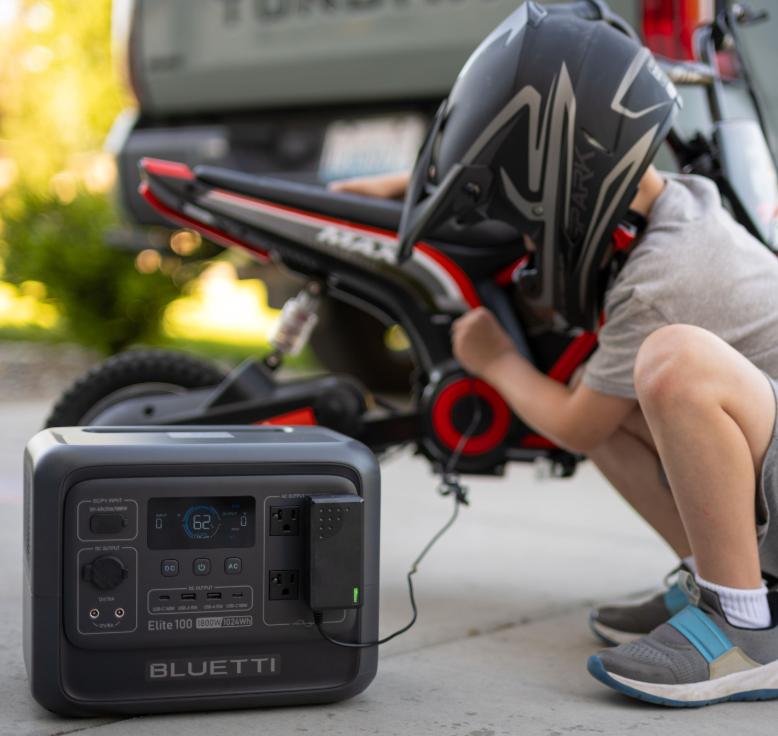
Elite 100 V2
A straightforward comparison with the DELTA 3 Plus when you want a 1kWh, 1,800W station.
Matching capacity and rated output do not establish matching noise, usable energy or accessory support.
A straightforward comparison with the DELTA 3 Plus when you want a 1kWh, 1,800W station.
Your decision depends on an unverified accessory, expansion path or particular computer riding through an outage.
- Nominal capacity
- 1,024Wh
- Rated AC output
- 1,800W
R1500 Lite
An alternative around the same capacity when your simultaneous AC load fits within 1,600W.
Its slightly larger nominal battery is paired with lower rated AC output than the two 1,800W models.
An alternative around the same capacity when your simultaneous AC load fits within 1,600W.
You need 1,800W continuously, or have confused it with the differently specified original R1500.

- Nominal capacity
- 1,056Wh
- Rated AC output
- 1,600W
02 / SIDE BY SIDE
Compare the same things.
Compare standalone batteries with standalone batteries. A solar kit or extra-battery bundle changes the cost, capacity and equipment you have to carry.
| The decision | EcoFlow DELTA 3 Plus | BLUETTI Elite 100 V2 | ALLPOWERS R1500 Lite |
|---|---|---|---|
| Nominal stored energy | 1,024Wh | 1,024Wh | 1,056Wh |
| Rated AC output | 1,800W | 1,800W | 1,600W |
| The important trade-off | Expansion changes the cost, size and carrying load. The standalone station is still 1,024Wh. | Matching capacity and rated output do not establish matching noise, usable energy or accessory support. | Its slightly larger nominal battery is paired with lower rated AC output than the two 1,800W models. |
| Read more | Our assessment → | Our assessment → | Our assessment → |
03 / BEFORE YOU PACK
The questions worth
asking first.
What will actually run?
List each device and how long it operates. Watts describe power at a moment; watt-hours describe energy over time. Add quantities, and distinguish an adapter’s maximum rating from measured average use.
Can you recharge reliably?
A wall outlet at the campsite changes the plan. Solar may help, but weather, shade, placement and compatible input limits affect what reaches the battery. Keep a no-solar plan for essential devices.
Can you carry the whole setup?
Check the station’s weight, the walk from the car and the space it occupies with cables connected. A panel or extra battery is another item to move and store. Exact dimensions and weight remain a separate model check.
Does the appliance need more than energy?
A compressor can require startup power beyond its running load. Check the appliance and station manuals together. Output-boost marketing is not a substitute for ordinary rated output or verified startup compatibility.
A WORKED EXAMPLE
One modest evening.
One clearer number.
Suppose your measured combined load is 50W and you need it for four hours. That is 200Wh at your devices. Using our illustrative 85% conversion efficiency, 10W idle draw and 20% reserve, the planning capacity is about 331Wh. It is a planning assumption, not a measured runtime for any model here.
Repeat the same four-hour use for two days without recharging and the target becomes about 661Wh. Add a fridge, change the temperature or leave the AC inverter on overnight and the result changes again. Put your own numbers into Power Match.
Calculate my setup ↗04 / YOUR QUESTIONS
A few things worth knowing.
Is a solar generator different from a power station?
Retailers often use solar generator for a battery station bundled with a solar panel. Check whether a panel is included, its specifications and its compatibility. The label alone does not tell you the battery capacity.
Will one station last the whole weekend?
That depends on your devices, use duration, available charging and usable energy. Divide the trip into the periods between reliable recharges and size each period. A number of days on a product card is not a guarantee for your equipment.
Can I run a camping refrigerator?
Possibly, but verify average energy use, compressor startup and output compatibility. Daily kWh measurements are more useful than multiplying an unknown maximum compressor rating by 24. Our estimator shows capacity candidates and flags motor loads for a separate compatibility check.
Can I use the station in wet weather?
Check the exact manual and environmental rating. A camping photograph is not proof of waterproof operation. Keep connections and equipment within their documented limits.
Should I just use a power bank?
For a phone or compatible USB-only devices, a smaller bank may be easier to carry and sufficient. A station becomes more relevant when you need suitable AC outlets, more stored energy or different charging options.
Have you tested these stations?
No. This edition is a specification-based assessment using manufacturer sources. We have not measured real-world energy delivery, charging noise or reliability.
EVIDENCE & CONTEXT
What we checked.
Baseline capacity, rated output and model identity were checked against the official US sources below. The analysis and worked example are ours. Prices and availability change; retailer links are ordinary links during this preview.
- EcoFlow DELTA 3 Plus — manufacturer evidence ↗
- BLUETTI Elite 100 V2 — manufacturer evidence ↗
- ALLPOWERS R1500 Lite — manufacturer evidence ↗
LESS GUESSWORK. A BETTER STARTING POINT.
Start with your devices.
Find your power.
A few practical questions turn an intimidating spec sheet into a clearer decision.